Thursday, June 25, 2015

Tallinn, Estonia -- May 18, 2015

Monday morning, we arrived in Tallinn (TAH-leen).  It was one of our favorite cities on our 2001 trip, so we were looking forward to seeing it again.  We were not disappointed.  Our first stop was the Alexander Nevsky Cathedral -- a Russian Orthodox church from the late 1800s.


About 500 feet due north is St. Mary's Cathedral, so I climbed the tower for pictures.  On the left is Alexander Nevsky Cathedral.  The tower on the right is Pikk Hermann.  The lower part of Pikk Hermann was built between 1360 & 1370 and is part of the Toompea (TOHM-pay-uh) Castle.


Then we went to the town square.


The town hall (built in 1404) had a tower, so...


...I climbed it and saw our boat.  Ours is the 3rd one (the "Huger" one).


I could also see the Alexander Nevsky Cathedral (center below) and the St. Mary''s Cathedral tower that I climbed earlier (on the right).


And this is what the town square looks like from the tower of the town hall.  The red arrow is pointing to Gwen and Alice.


Below the tower was a small medieval restaurant where we ate lunch.


Dave and I had elk stew and we all had apple turnovers.


There was a wall built around Tallinn in the 1300s.  The Viru Gate is part of that original wall.  The picture below shows Gwen and Alice exiting the old part of town through the Viru Gate.


This last picture is taken outside the Viru Gate, looking back at the old part of town.

Wednesday, June 24, 2015

At Sea -- May 17, 2015

Sunday, we spent the entire day on the boat.


The picture above was taken Saturday night as we returned from Berlin.  Since there were no church services on the boat, we slept until almost noon.  Our cabin was located just above the 4th or 5th lifeboat in the picture.  We had a nice dinner with Gwen and Dave, then...


...watched the sun go down.

Berlin, Germany (Deutschland) -- May 16, 2015

Saturday, we docked in Warnemunde, Germany and took a 3-hour train ride to Berlin.  Our tour of Berlin began at the Victory Column.  It was designed in 1864 to commemorate the Prussian victory in the Danish-Prussian War, but by the time it was inaugurated in 1873, Prussia had also defeated Austria in the Austro-Prussian War (1866) and France in the Franco-Prussian War (1870–71). 


 Our next stop was the Reichstag.  It opened in 1894 and housed the German parliament until it was damaged by a fire in 1933.  It was fully restored between 1990-1999 and once again became the home of parliament.


Our third stop was the Brandenburg Gate.  It was erected as a symbol of "peace" in 1791.  It underwent a complete restoration between 2000-2002, so it was covered when we visited Berlin in 2001.  It was nice to actually see it this time.


Standing on the other side of the Brandenburg Gate, the Reichstag is visible about a block away.


Next, we visited the Gendarmenmarkt Square.  The square contains 3 major buildings: the French Cathedral, built in 1705 (in the center of the picture below), the Concert House, built in 1821 (on the left), and (behind the camera)...


...the German Cathedral, built in 1708 (which faces and resembles the French Cathedral).


Checkpoint Charlie was one of the few places to cross between East and West Berlin during the Cold War/Berlin Wall era.


We then visited Humboldt University.  It was in this square that the Nazis burned 20,000 books on May 10, 1933.


Not much of the Berlin Wall is left, but I salvaged a small piece of it from here.

Friday, June 19, 2015

Gothenburg (Göteborg), Sweden (Sverige) -- May 15, 2015

Our next stop was Göteborg.  (In Swedish, a "g" is pronounced like a "y" and "ö" is pronounced "uh," so it is pronounced "yuh-tuh-BOH-ry.")  The first place we visited was the Haga, which is a neighborhood that was first established in the mid 1600s.  Since it was outside the city wall, it became Göteborg's first suburb.  As much as possible the original architecture has been preserved and it is now a popular shopping area.


 Our favorite shop was Café Husaren...


...which claims to have the world's largest cinnamon buns.  I don't know if they're the biggest, but they're definitely tasty.  They look like they have salt sprinkled on top (like a pretzel), but it's really sugar.


Just south of the Haga, on a hill overlooking it, is the Skansen Kronan -- a fortress that was built in 1698 with 23 cannons to protect the south end of Göteborg.


Of course I climbed up the hill to get these pictures of the city.


Göteborg's famous fish market, Feskekörka (literally translated as "Fish Church" because it resembles a gothic church), was built in 1874.


Alice made friends with all the statues outside.

Wednesday, June 17, 2015

Oslo, Norway (Norge) -- May 14, 2015

For me, the nice thing about a cruise ship is that dinner, sleeping, and breakfast all happen in one enclosed space -- WHILE traveling to the next destination.  The bad thing is that the sightseeing has to be kept to few hours or you'll miss the boat (so to speak).  For Alice, the boat is more fun than the sightseeing, so it works perfectly for her.  Our first stop was Oslo (pronounced "oosh-lu") and we took a taxi to the Viking Museum.


The ship in the top picture is 70 feet long, almost 17 feet wide, its mast was over 30 feet high, and it could go up to 11 mph.  It was built prior to 800 A.D. and was found in a burial mound.  (Apparently, some vikings had their ships buried with them.)  Perhaps one of the most amazing things is the detailed wood carving done by these people who are often classified as "medieval, pagan, and pirates."


As we were walking from the Viking Museum to the Kon-Tiki Museum, we saw some "Hop On Hop Off" buses go by.  We talked to one of the bus drivers at the Kon-Tiki Museum and found that they were cheaper and more convenient than a taxi or a rental car (for less than the price of a taxi, we were able to buy a 24-hour pass that stopped about every 20-30 minutes at the boat as well as all the major attractions in each city), so they became our primary mode of transportation.  At the museum, we saw the "Kon-Tiki," which was the raft (below) that Thor Heyerdahl used to sail from Peru to an island near Tahiti in 1947.


The museum also houses the "Ra II," which is a papyrus ship (below) that Heyerdahl used to sail from Morocco to Barbados in 1970.


Our boat docked in the Oslo Fjord (which in the geological sense, is not really a fjord, but an inlet from the Baltic Sea).  Below is the Oslo "Fjord," a view of the boat from Olso, and a view of Oslo from the boat,


The sunset was magnificent as we left the Oslo "Fjord."

Tuesday, June 16, 2015

Copenhagen to Cruise Ship -- May 13, 2015

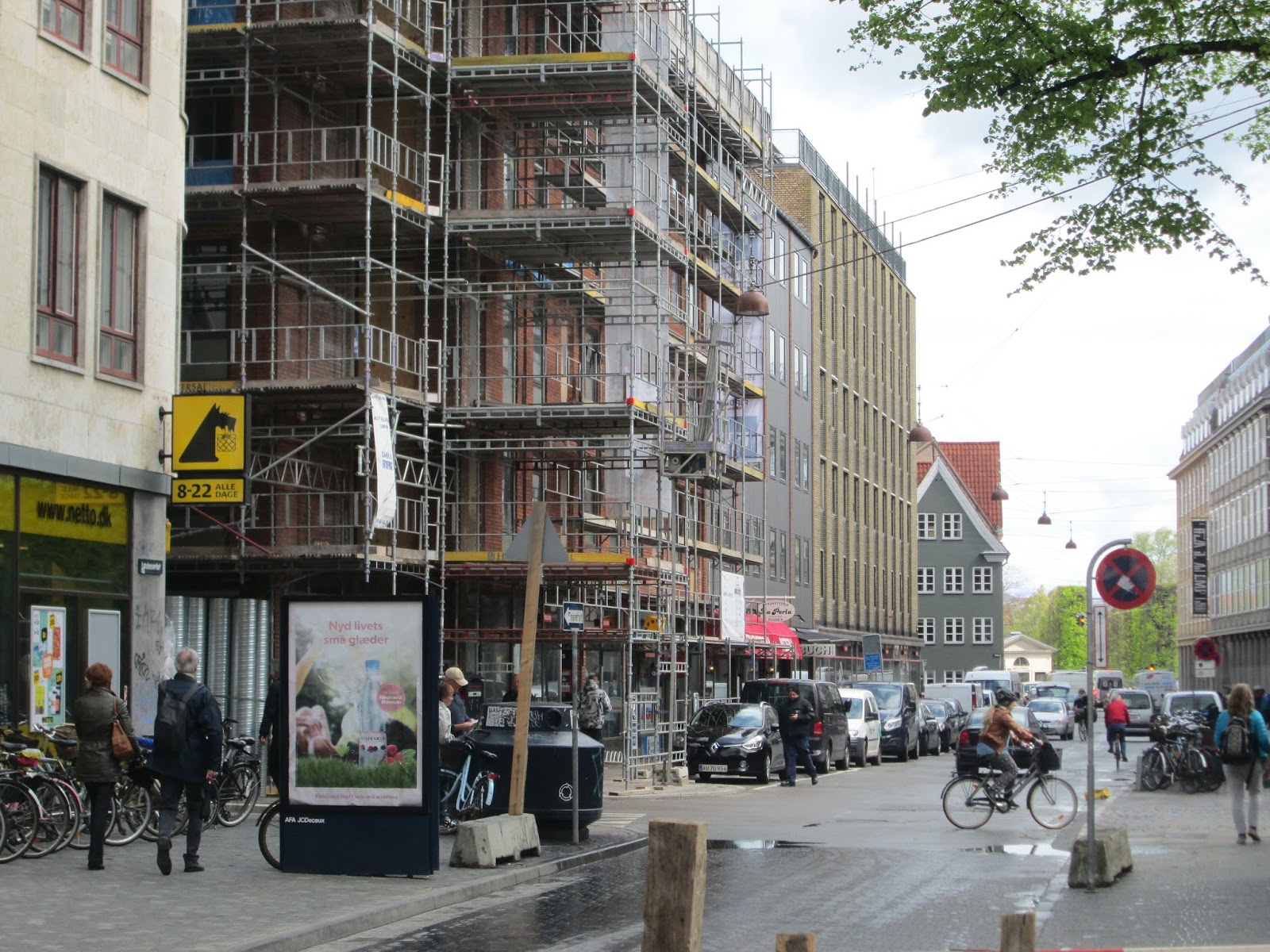
Wednesday morning began exactly like Tuesday.  We loved our "Netto Market" breakfast so much that we repeated it again.  The picture on May 12th was cropped from this one.


While the others explored below, I climbed this tower...


... and saw this view (with the Vor Frue Church on the left)...


and this view (with the bridge to Sweden in the center on the horizon).


Our last stop before getting on the boat was the Kastellet, a military installation that was built in 1662.  It has a moat around it that creates an island in the shape of a pentagram.


As we approached the harbor, we saw a cruise ship and one of us said, "That is HUGE!"  Then we saw our ship, the Regal Princess (14th largest in the world), and Dave said, "Yeah, but ours is HUGER!"  So, from that moment on, we referred to our boat as "HUGER."


It had 16 decks with an atrium in the middle on Deck 5 that extended upwards to the top of Deck 7.


Our cabin, on Deck 9, had a double bed, bathroom facilities, a fridge, a big screen TV, and a balcony.